


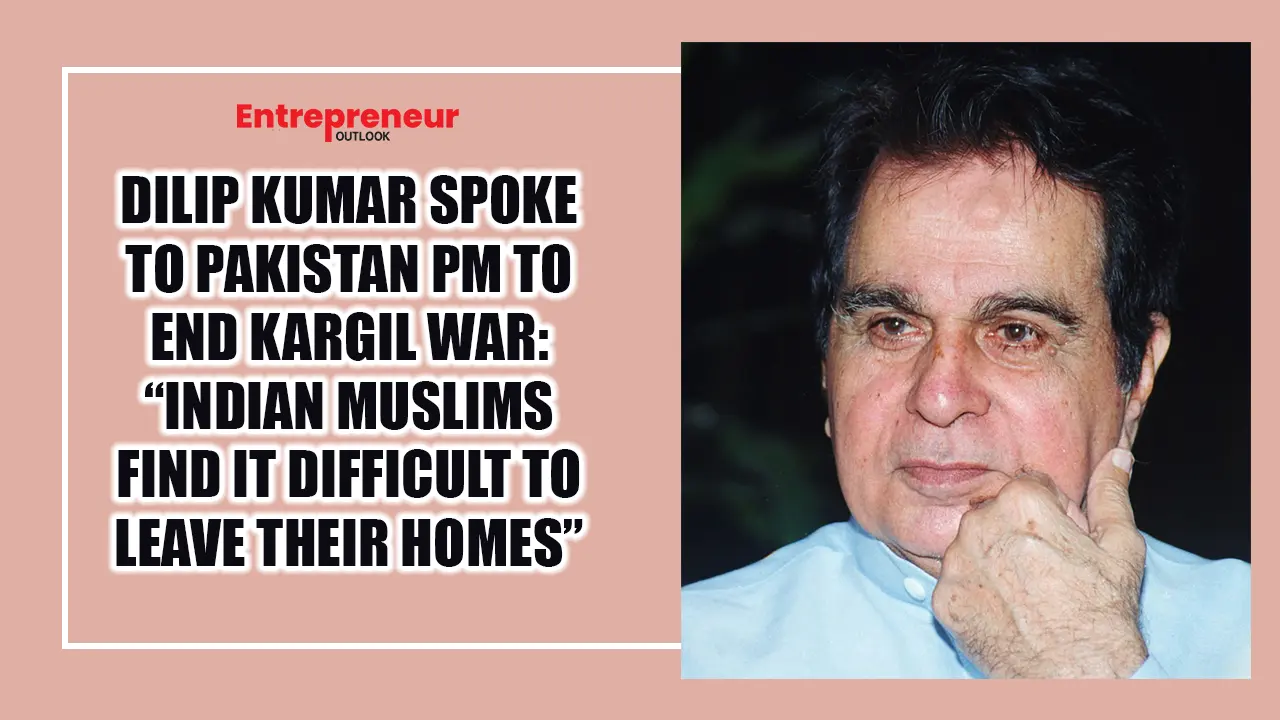
One of India’s biggest movie stars was the late Dilip Kumar. The actor was also highly respected in the neighboring nation, Pakistan, where he was born. As a result, Dilip Kumar made an effort to mediate a settlement between the two countries when the India-Pakistan conflict started at Kargil in 1999. He also had an exchange with Nawaz Sharif, the prime minister of Pakistan at the time.
According to reports, Atal Bihari Vajpayee, the Indian prime minister at the time, organized the call. Dilip Kumar stated, “Mian Sahib, we did not expect this from you since you have always claimed to be a great supporter of peace between Pakistan and India,” based to an SCREEN report.
“Let me tell you as an Indian Muslim that in case of tension between Pakistan and India, Indian Muslims become very insecure and they find it difficult to even leave their homes,” he allegedly added. Please take action to manage this situation.
During his visit to India in 2015, former Pakistani foreign minister Khurshid Kasuri said that Vajpayee had called Sharif to discuss Kargil. He stated that Saeed Mehdi, Sharif’s senior principal secretary, provided him with this information.
“According to Saeed, one day he was sitting with PM Sharif when the telephone bell rang, and the ADC informed the PM that the Prime Minister of India, Atal Bihari Vajpayee, wished to speak with him urgently,” Kasuri told PTI.
Sharif asserted that he was unaware of the critical situation in Kargil as Vajpayee voiced his dissatisfaction. Vajpayee then instructed him to talk to Dilip Kumar, the man sitting next to him.
According to reports, following this meeting, hostilities temporarily subsided. But things did ultimately get worse. The conflict lasted for three months.
Born Muhammad Yusuf Khan, Dilip Kumar continues to be one of the most important and innovative characters in Indian film. With a career spanning more than 50 years and performances that significantly changed the grammar of screen acting in India, his legacy is intimately linked to the growth of Hindi cinema.
Although his family moved to Bombay in the 1930s, Dilip Kumar was born in Peshawar. When his father was ordered to return to Peshawar after the Partition, Dilip Kumar reportedly objected and said that he would live and die in India.
FAQs
Did Dilip Kumar really speak to the Pakistan Prime Minister during the Kargil War?
Yes, according to multiple reports, Dilip Kumar spoke to then Pakistan Prime Minister Nawaz Sharif during the 1999 Kargil conflict in an effort to de-escalate tensions.
Who arranged the call between Dilip Kumar and Nawaz Sharif?
Reports suggest that the call was arranged by then Indian Prime Minister Atal Bihari Vajpayee, who asked Nawaz Sharif to speak with Dilip Kumar during their conversation.
What did Dilip Kumar say to Nawaz Sharif during the Kargil conflict?
Dilip Kumar reportedly expressed disappointment and highlighted that during India-Pakistan tensions, Indian Muslims feel insecure and find it difficult to even step out of their homes.
Why was Dilip Kumar involved in diplomatic efforts during Kargil?
Dilip Kumar was highly respected in both India and Pakistan due to his stature as a legendary actor and his birthplace in Peshawar, making him a trusted voice for peace.
Is there official confirmation of this conversation?
Former Pakistani foreign minister Khurshid Kasuri later referenced this account, citing information from Nawaz Sharif’s senior principal secretary, lending credibility to the reports.
Did the call help reduce tensions between India and Pakistan?
According to reports, hostilities briefly subsided after the conversation, though the conflict eventually escalated and continued for nearly three months.
Where was Dilip Kumar born?
Dilip Kumar was born as Muhammad Yusuf Khan in Peshawar (now in Pakistan) before his family moved to Bombay in the 1930s.
Did Dilip Kumar consider moving to Pakistan after Partition?
No. Reports state that when his father was asked to return to Peshawar after Partition, Dilip Kumar firmly said he would live and die in India.
Why is Dilip Kumar considered a legend of Indian cinema?
With a career spanning over five decades, Dilip Kumar revolutionized screen acting in Hindi cinema and remains one of its most influential figures.
Must Read:

