


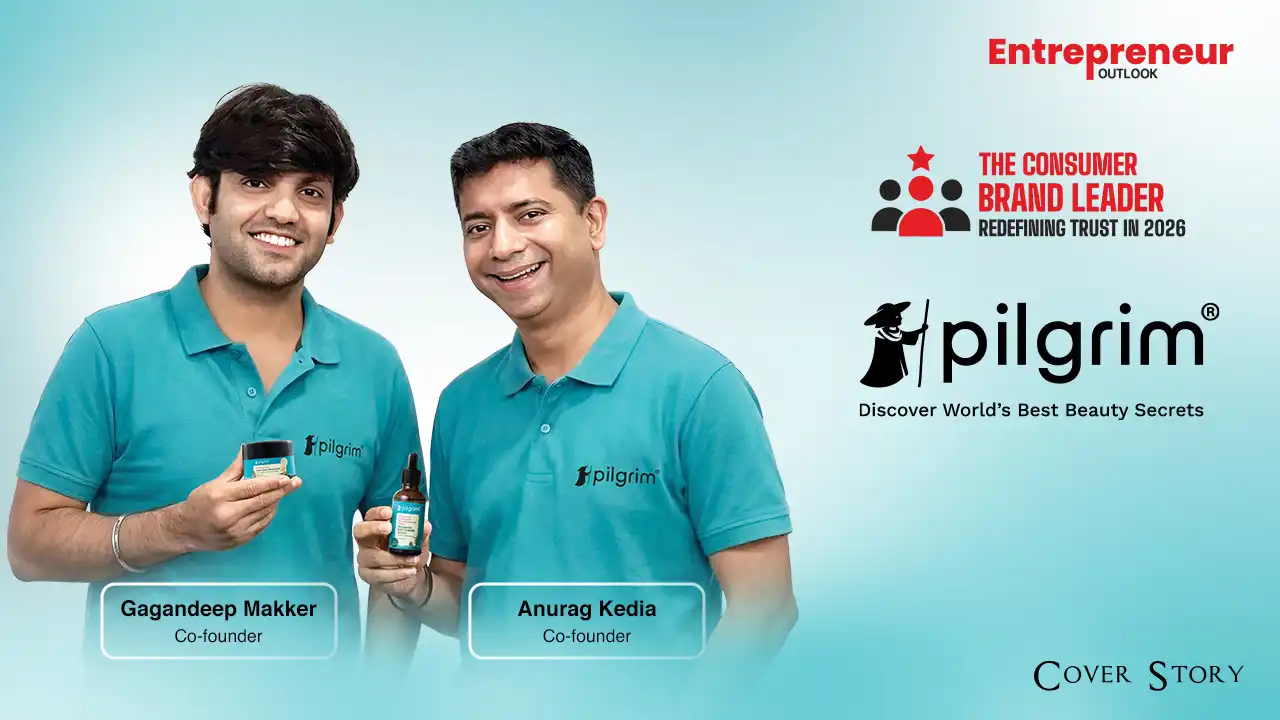
In 2020, when the world was shutting down due to the covid-19 pandemic and uncertainty had become the only constant, a young Indian beauty brand decided to open the windows to new possibilities. Yes, we are talking about none other than Pilgrim. Founded by Anurag Kedia and Gagandeep Makker, Pilgrim did not launch with celebrity noise or dramatic billboard takeovers. It entered the market with something far more powerful i.e. curiosity.
As per the co-founders, curiosity about how Korean women swore by rice water,about why Australian Kakadu Plum carried some of the highest natural Vitamin C concentrations in the world, or about the way French vineyards contributed more than just wine to global exports, gave them a platform build an iconic brand which Pilgrim today is. However, what gave them a breakthrough was curiosity about why Indian consumers had to discover these secrets only when they travelled abroad.
This exclusive read takes you to a fantastic journey of how an Indian beauty brand gradually geared up to compete with the global beauty products and succeeded with flying colours. Let’s dive in the story shared by the co-founder in a special conversation held with our team:
Simple idea but tough execution
Anurag opened the discourse by sharing the founding belief behind Pilgrim was refreshingly straightforward: the world’s best beauty secrets deserve to reach every Indian doorstep. But as any entrepreneur, or journalist who has tracked entrepreneurs for two decades, will tell you, simplicity in thought often demands complexity in execution. The Indian beauty market is not easy for a new brand to settle in.
It is crowded, price-sensitive, trenddriven, and increasingly informed. Consumers scroll, compare, research, and question before they click “add to cart.” Ingredient literacy has grown dramatically. Words like vegan, paraben-free, cruelty-free are no longer niche, they are expected. Pilgrim stepped into this evolving ecosystem not by shouting louder than competitors, but by speaking more clearly.
Beauty Secrets, Local Realities
When asked how they cracked the secret of success in this industry, Gagandeep responded that there is a certain vibe in saying your ingredients come from Korea, Spain, France, or Australia. But a vibe alone does not solve Indian skin concerns. Indian climate is humid in some regions, dry in others, and aggressively sunexposed in most. Hyperpigmentation, tanning, dehydration, acne triggered by pollution, and scalp issues aggravated by heat are everyday realities for common people in India.
What Pilgrim did differently was adapt to the change. They brought White Lotus and Rice Water from Korea. Yes, it highlighted Squalane from Spanish Olives and Red Vine extracts from France. Yes, it spoke about Kakadu Plum from Australia. But formulations were adjusted for Indian weather patterns. Textures were made lighter. Absorption faster. Hydration deeper without heaviness. Products are dermatologically tested and formulated for efficacy, keeping Indian consumers in mind.
Timing the Consumer Shift
If you have covered India’s consumer economy long enough, you learn to identify inflection points. Beauty, over the last five years, has witnessed one. The Indian buyer today is not impressed by packaging alone. She flips the bottle and reads the ingredient list. She searches online reviews before purchasing. Gen Z and millennial consumers openly question brands about sourcing, sustainability, and ethics. Now the consumers have become so much aware of multiple aspects of making a purchase.
Therefore, Pilgrim arrived at precisely this cultural pivot. With over 250+ products spanning skincare, haircare, and makeup, the brand positioned itself not just as a seller, but as an educator. Ingredient stories were simplified. Science was translated into everyday language.
The brand invested in explaining what goes into a formula, and why. The results have been telling. With an Annual Run Rate reportedly crossing ₹1000 crore and a growing retail footprint, Pilgrim has scaled at a pace that even seasoned industry observers note with interest. It now caters to millions of customers and is gradually expanding into international markets including the US, Southeast Asia, and the Middle East.But numbers, while impressive, are only one part of the story.
Surviving as well as Standing Out in the D2C Chaos
The D2C beauty battlefield in India is intense. New brands launch with influencer campaigns. Discounts drive traffic spikes. Algorithms decide visibility. Attention spans are short. Pilgrim’s differentiation has been steady rather than sensational. Instead of chasing aggressive discount wars, it leaned into premium-quality formulations at accessible prices.
Instead of relying solely on celebrity endorsements, it collaborated with creators and dermatology experts who could communicate product science authentically. Trust, in beauty, compounds slowly. And Pilgrim appears to understand the long game. Transparency about ingredients. Clear claims. Clean positioning. GMP-certified manufacturing. Dermatological testing. Stability assessments. Compliance with Indian and international standards. These may sound like operational details, but in a sector plagued by exaggerated marketing claims, they become competitive advantages.
Technology Behind the Glow
Modern beauty brands are as much data companies as they are cosmetic manufacturers. Pilgrim uses consumer feedback loops, social listening insights, and purchase behaviour analysis to inform new launches. AI-powered recommendation tools help customers identify suitable routines based on their concerns. Demand forecasting improves inventory planning and reduces wastage. For a brand that began with the idea of discovery, technology has become its compass. And this fusion of data with beauty is perhaps where the industry is headed next which is personalization at scale.
Sustainability is beyond the Buzzword
Sustainability in beauty often risks becoming a surface-level narrative—the real test lies in how deeply it is embedded within operations. Pilgrim focuses on measurable impact through responsibly sourced ingredients, ethical partnerships, and transparent formulations.
The brand is plastic-positive, recycling more plastic than it consumes, and has reduced packaging impact by cutting order box paper usage by ~50%, saving 300– 500 MT annually. It also tracks plastic intensity, improving from ~900 kg per crore in FY21 to ~765 kg in FY25 through value engineering. As consumers increasingly align purchases with values, the future of beauty will belong to brands that demonstrate measurable responsibility, not just promise it.
The Power of Community
Perhaps one of Pilgrim’s strongest strategic decisions has been its focus on building what it calls the “Pilgrim Tribe.” Community, in today’s digital economy, is currency. By collaborating with thousands of creators, amplifying user-generated content, and encouraging open reviews, the brand has cultivated dialogue rather than monologue. Consumers feel heard. Their feedback shapes iterations. Their stories become marketing assets.
This approach is reflected in Pilgrim’s growing digital footprint – having crossed 1M+ followers on Instagram in 2026, placing it among the top-performing beauty brands on the platform in India. This scale is not just a vanity metric but a strong indicator of engaged community-led growth. As someone who has watched multiple consumer brands rise and fall, the co founders can say this, advertising buys visibility. Community builds longevity for a brand.
Scaling Comes with Friction
National expansion is never frictionless. Logistics across India’s diverse geographies are complex. Supply chains can strain under demand spikes. Tier-II and Tier-III markets require deeper consumer education. Pilgrim’s strategy appears rooted in operational partnerships, supply chain optimization, and continued investment in awareness-building. More importantly, it has maintained clarity of positioning i.e. global ingredients adapted for Indian needs. That clarity acts as a stabilizing anchor amid rapid growth.
From Importer of Secrets to Exporter of Standards
If the first chapter of Pilgrim’s journey was about bringing the world to India, the next may well be about taking India to the world. International expansion is already underway and the top priority in the bucket list. AI-driven personalization is poised to deepen. Clean beauty innovations are expected to accelerate. But the larger question is: can Pilgrim evolve from being a fastgrowing D2C success story into a globally respected beauty house? That transition demands more than scale.
It demands consistency, innovation, and unwavering consumer trust. From where it stands today, Pilgrim appears conscious of that responsibility. In a market where many brands chase virality, Pilgrim has chosen vocabulary, validation, and vision. And if there is one thing twenty years of business reporting teaches you, it is that trends fade, but disciplined brand-building endures. Pilgrim did not simply launch products. It launched a journey. And for millions of Indian consumers, that journey began with a passport stamped not at an airport, but on a bathroom shelf.
Must Read:

