


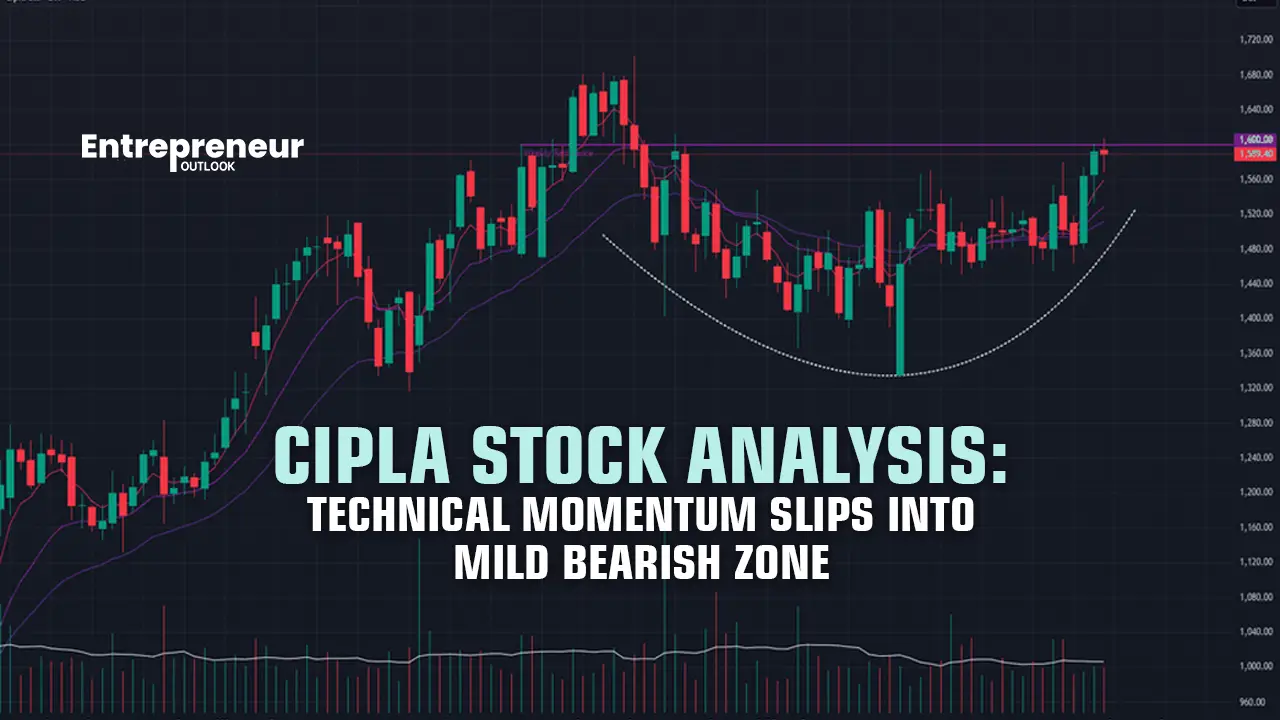
The technical momentum of Cipla Ltd., a key player in the pharmaceuticals and biotechnology industry, has briefly but clearly changed, moving from a moderately positive outlook to a mildly bearish position. The stock‘s technical indicators provide a complicated picture, with confusing result from MACD, RSI, moving averages, and other momentum oscillators, despite a little day increase of 0.73%. This study explores the latest technical advancements and places Cipla’s price movement in the context of both its past performance and more general market trends.
Overview of Technical Momentum
The price of Cipla is currently 1,530.35, which is somewhat higher than the previous closure of 1,519.30. With a high of 1,672.20 and a low of 1,310.05, the stock’s 52-week range is still wide and shows notable volatility over the year before. A cautious stance among traders and investors is apparent by the recent technical trend, which changed from moderately positive to mildly negative.
A key momentum indicator, the Moving Average of Convergence Divergence (MACD) indicator, displays a modestly negative position on the monthly chart and a bearish indication on the weekly chart. This implies that the longer-term trend is only somewhat negative, indicating some underlying resilience, even while the short-term impetus is waning.
Weekly and monthly Relative Strength Index (RSI) values are now in neutral category with no clear signal. Cipla may move in either way depending on future triggers because there are no momentum extremes, suggesting that it is neither oversold nor oversold.
On weekly and monthly charts, Bollinger Bands show sideways movement, which supports the idea of consolidation rather than a distinct breakout or fall. For technical analysts, the present phase is crucial since this sideways price movement frequently precedes an imortand move.
Moving Averages and Extra Factors
The stock price is continues to close below important short-term averages, and daily moving averages have become quite gloomy. This change suggests that the bears may be slowly taking control and that the previous rising momentum has paused. This viewpoint is supported by the Know Sure Thing (KST) oscillator, which highlights the cautious technical outlook by displaying negative momentum on the weekly chart and slightly bearish on the monthly.
The Dow Theory research offers a complex picture: monthly trends have become somewhat negative, representing longer-term caution, but weekly trends are still somewhat positive, suggesting some short-term confidence. This disparity highlights how crucial it is to keep an eye on both time periods for a more obvious directional bias.
On the weekly scale, On-Balance Volume (OBV) fegures are somewhat negative, indicating that volume flow is not substantially assisting price increases. Long-term market participants’ lack of conviction is indicated by the monthly OBV’s absence of a discernible trend.
Market Context and Comparative Performance
When comparing Cipla’s returns to the benchmark Sensex, the company has did better in the short and medium terms but worse in the long run. For example, Cipla produced a 2.61% return over the previous week compared to the Sensex’s 0.46% and a 0.64% gain over the previous month compared to the Sensex’s 0.76% decrease. The Sensex has dropped 0.18% so far this year, whereas Cipla has up 1.29%, showing relative strength in recent months.
But over the course of a year, Cipla’s 2.70% return lags behind the Sensex’s strong 9.10% increase. Cipla has shown strong long-term growth, with returns over three and five years of 42.17% and 85.50%, respectively, that roughly match or surpass the Sensex’s 42.01% and 76.57%. The market as a whole has performed well over the last ten years, as seen by the 10-year return of 134.57%, which is lower than the Sensex’s 234.81%.
This inconsistent relative performance is consistent with the technical signals, indicating that Cipla is going through a period of recalibration and consolidation in the face of changing market conditions.
Revision of the Mojo Score and Rating
MarketsCipla now has a Mojo Score of 50.0 based on MOJO’s patented ranking technique, and as of October 30, 2025, its Mojo Grade was lowered from Buy to Hold. The recent technical decline and the cautious outlook from several indicators are seen in this lower rating. From a technical standpoint, Cipla’s Market Cap Grade of 1 indicates that it is a large-cap stock with substantial market presence but no imminent upside.
As the stock’s momentum signals do not yet support a strong buy or sell conviction, investors should be aware that the Hold rating advises a wait-and-watch strategy. Cipla may be settling down until a more obvious directional move appears, according to the neutral RSI readings and modestly negative technical trend.
Prospects and Strategic Aspects
Cipla’s short-term price movement is probably going to be range-bound between support at 1,510 and resistance at 1,540 given the present technical environment. While a decline below 1,519.30 could validate the negative bias indicated by MACD and moving averages, a clear break above the recent high of 1,539.25 could suggest fresh new momentum.
The somewhat negative monthly MACD and KST suggest that the stock’s overall trend may be under pressure, so longer-term investors should keep a careful eye on monthly indicators. Cipla is not in a troubled technical position, nevertheless, as seen by the lack of severe RSI readings and sideways Bollinger Bands, which might lead to a comeback if fundamental triggers materialise.
Must Read:

