


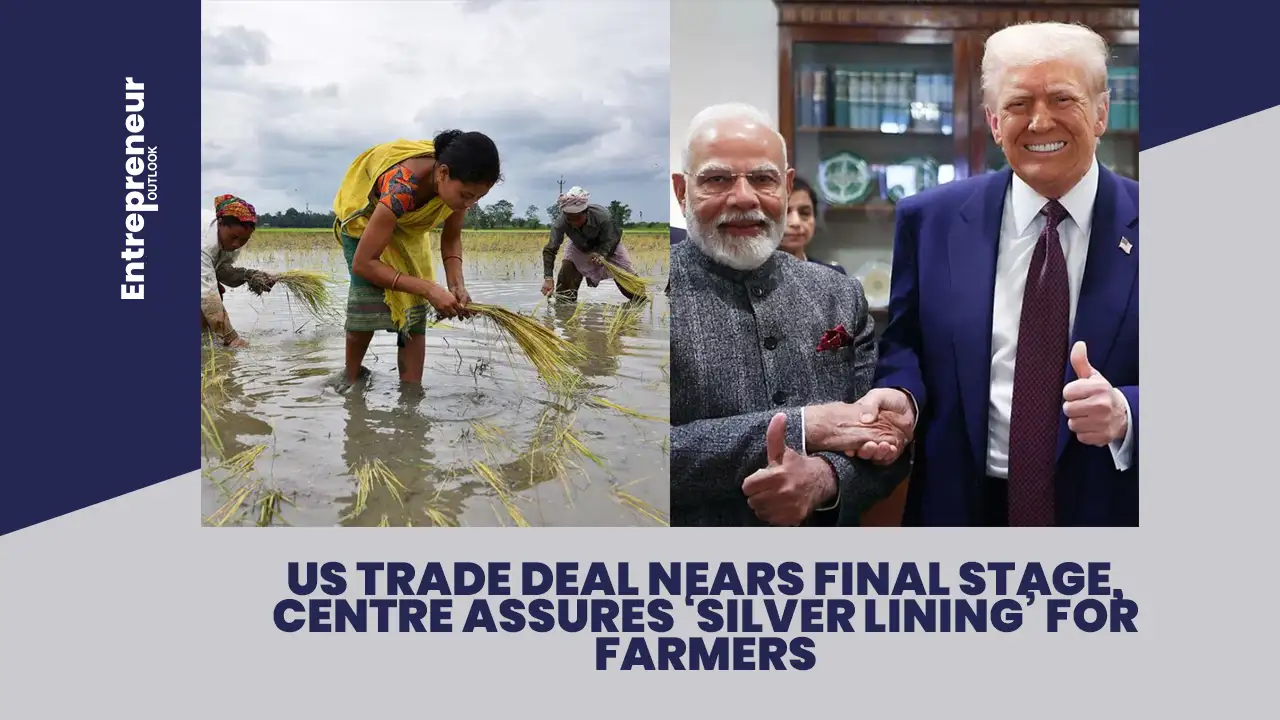
India–US Trade Deal Nears Finalisation
The government said on Wednesday that a historic trade deal between the United States and India is about to be finalized, promising to strengthen bilateral economic connections while protecting India’s fundamental agricultural interests. Even while the agreement opens up new export options for Indian farmers and industries, senior ministers have stressed that there has been no compromise on sensitive areas like dairy and agriculture.
Shivraj Singh Chouhan, the Union Minister for Agriculture and Farmers’ Welfare, strongly rejected claims made by the opposition that the planned trade agreement between the US and India will hurt farmers in his country. Speaking to the media in New Delhi, Chouhan stated that there is “no threat whatsoever” to India’s basic cereals, millets, fruits, or dairy products and that the deal completely protects the interests of both small and large farmers.
Chouhan started that “farmers’ interests are paramount and non-negotiable,” adding that the agreement has no allowing permitting the abrupt or disruptive introduction of agricultural products from other countries into Indian markets. He said that the current protections for important agricultural commodities are still in place, and that all major crops, food grains, fruits, and dairy products are still protected.
PM Modi’s Leadership Central to Trade Negotiations
The Agriculture Minister underlined that Prime Minister Narendra Modi’s leadership developed the agreement, which reflects India’s larger diplomatic strategy focused on development, dignity, and national interest. “The Prime Minister stated right away that the welfare of farmers cannot be compromised. For Indian agriculture, this deal brings chances rather than dangers, according to Chouhan.
Chouhan started that Commerce Minister Piyush Goyal had previously provided clarification in Parliament in response to worries raised by a recent social media post by a US official proposing expanded access for American agriculture products. He reaffirmed that India has not extended its markets in a way that would expose home farmers to unfair competition or put pressure on them.
The administration also emphasized the significant export benefits anticipated from the deal. Lower tariffs are expected to increase India’s exports of textiles, rice, and spices—industries in which the country already has a significant worldwide footprint. According to Chouhan, India recently reported rice exports of over Rs 63,000 crore, and it now sells rice to a number of nations, including the United States. Millions of cotton farmers nationwide would immediately profit from an increase in textile exports, he continued.
External Affairs Minister S Jaishankar reiterated the government’s stance by stating that the trade agreement is currently in the latter phases of development. Jaishankar thanked US Secretary of State Marco Rubio for his kind welcome and termed the talks as fruitful and pleasant in a post on X after his trip to the US.
“The historic India-US trade deal is in the final stages and will be completed very soon,” Jaishankar stated, descibing it as the start of a new chapter in bilateral relations with “vast possibilities” for collaboration. Additionally, he highlighted the quick development of crucial mineral cooperation and said that in the upcoming days, engagement on defense, energy, and strategic issues is expected to increase.
In an era of global volatility, officials saw the pact as a component of a larger initiative to fortify India-US strategic and commercial ties. The administration has insisted that its fundamental tenet—the wellbeing of Indian farmers—remains constant, even though specifics of the agreement would be disclosed when they are ready.
Chouhan made an emotive plea, calling farmers the country’s “Annadata”—providers of life—and stressing that worshiping them is the same as serving them. “Their welfare is the nation’s welfare,” he declared, promising that while India forges a new path in its trade ties with the United States, the PM Modi administration will remain steadfastly with farmers at every turn.
Must Read:

